Tantra is a way of doing
Let's begin with the word itself, because the word carries the whole method.
Tan — to extend, to expand, to weave the loom. Tra — to liberate.
A tool for expansion. An instrument of liberation. Notice that both halves of the word are practical. Tantra isn't primarily a set of beliefs you sign up to — it's a set of things you do.
This is what distinguishes it from its philosophical cousins. Vedanta and Samkhya are largely theoretical systems: exquisite maps of reality, but maps. Tantra is fundamentally practical. It offers a cosmology and the litany of practices by which you can verify that cosmology in your own body. The word darshan means to glimpse, to see directly. Tantra Darshan is to behold the liberation of energy for yourself — not to read about it.
At the heart of tantric practice is ritual, which is simply bringing reverence to action. Everything downstream of that — every technique in the system — is a form of reverent, intentional doing.
The premise: Shiva and Shakti
The whole architecture rests on one elegant idea.
Shiva is pure consciousness — unchanging, still, formless. The witness. Shakti is dynamic energy — the creative force of manifestation and change. That which is witnessed.
They are not two things. They are two faces of one reality, inseparable, and the entire manifest universe arises from their interplay. In the tantric telling, creation itself began with Shiva's desire to witness itself.
Within the human body this cosmic polarity is mirrored exactly. Consciousness sits at the crown; Kundalini Shakti lies latent and coiled at the base of the spine. The work of practice is to reunite them.
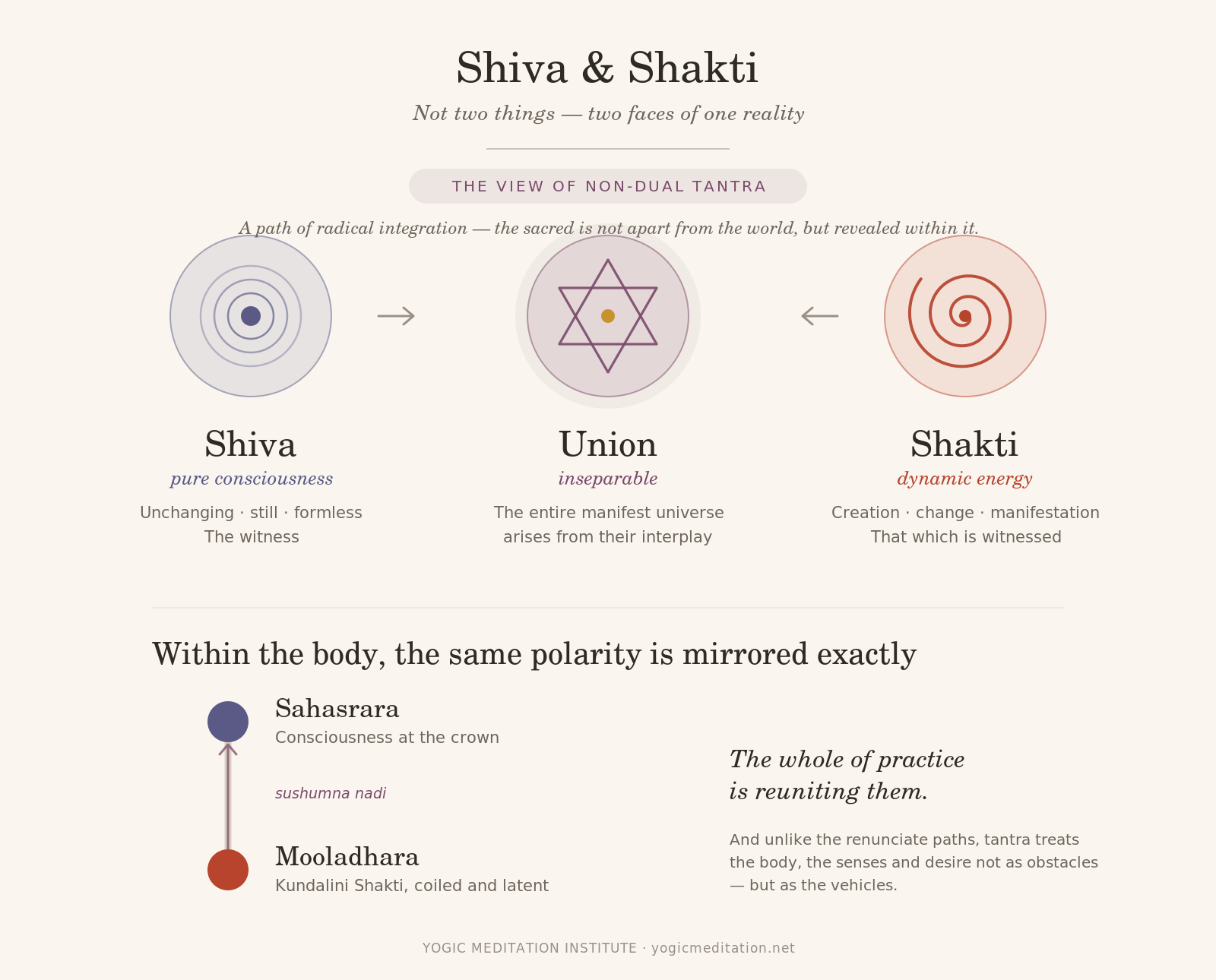
And here is where tantra parts company with the renunciate paths. Where Vedanta often emphasises transcendence and turning away from the world, tantra affirms embodiment. The body, the senses, even desire are not obstacles to liberation — they are the vehicles for it. The sacred is not somewhere else. It is revealed right here, in this life, in this body, in the muck of ordinary daily living.
Prana: the actual subject of study
If Shiva and Shakti are the premise, prana is the subject.
Tantra is, at its core, a science of energy. Prana — life force — is a form of Shakti, often called Prana Shakti, the animating force behind all manifestation. Tantric practice is fundamentally about becoming intimate with this force: learning to feel it, to direct it, to refine it, and eventually to merge with its source.
A useful analogy: just as we experience H₂O as ice, water and vapour, prana can be observed at different densities. Ice can be melted; water can be turned to steam. In a lighter, more mobile form, prana becomes far easier to move — and heat is what mobilises it. This is why so much of hatha yoga is, quite literally, about generating warmth.
And prana is everywhere. In the rocks and trees, in the breath moving through the nostrils, in the emotions rippling through the heart, in the cosmic winds that stir the galaxies. Every experience is an intersection of prana and consciousness — and every one of those intersections is an opportunity for awakening. This is why the tantric Upanishads cheerfully explore energy dynamics within money, food, sexuality, architecture and music. Everywhere prana flows, tantra goes.
What actually blocks it
Three Sanskrit terms do a lot of work here, and they're worth learning:
Samskara — a sense impression. A single deposit left by experience.
Varsana — an accumulated collection of similar samskaras. These become the impediments in the flow of the Sushumna Nadi.
Vritti — the resulting modification of thought and behaviour. The interruption to prana's flow that you actually notice in daily life.
Picture Kundalini as a reservoir, the Sushumna Nadi as the river flowing out of it, and your varsanas as the silt and debris restricting that river. The practice isn't about forcing more water through. It's about clearing the channel.
Of the 72,000 nadis described in the tradition, three matter most: Ida (lunar, feminine, the parasympathetic nervous system), Pingala (solar, masculine, the sympathetic), and Sushumna, the central channel within the spinal column through which Kundalini rises when the way is clear.
The tantric toolkit
So what are we actually doing? The methodology is broad, and it's worth seeing it laid out in full:
The ritual tools
Yagya — ceremony
Puja — offerings
Mantra — sacred sound
Yantra — sacred geometry
The hatha yoga tools
Shatkarma — cleansing practices
Asana — posture
Mudra — gesture, energetic seal
Bandha — energy lock
Pranayama — breathwork
Kriya — psychic action, usually combining several of the above
Yoga Nidra — awakened sleep, derived from the tantric practice of Nyasa
Dharana — concentration and meditation (competence with dharana is essential for success with the other tools)
Mantra and yantra are the same principle expressed twice: name and form. The sound liberates energy trapped in limiting mental patterns; the corresponding visual symbol concentrates awareness. Sound and shape, working the same knot from two sides. Each chakra has both a bija (seed) mantra and a corresponding yantra, which is simply that mantra made visible.
One more thing about this list, and it matters: the practices are staged. Every technique in the tantric system has a clearly defined progression from beginner to advanced. Tantra meets you wherever you are and invites you to begin from your present reality — regardless of age, stage of life, experience or interest. There is no entry exam.
Chakra psychology: tuning the instrument
Now to the part that tends to land hardest for people.
The chakras are described in the tantric Upanishads as wheels or vortices governing the body's energy and emotions, and they map closely onto the endocrine system. But their real value in practice is as a system of self-analysis — a yogic psychology.
An important clarification: the chakras don't create life force. As Anodea Judith frames it, they are managers — they receive, assimilate, store and express energy through the koshas, the layers of our experience.
Here's the analogy I keep coming back to. A human being is a stringed instrument.
Before you play a guitar, you tune it. You take each string in turn and bring it into pitch, because the instrument only sings when the whole thing is harmonised. Chakra psychology invites us to do exactly this: to meditate on and cultivate a practice for each chakra in turn, so that our inner instrument — the antarkarana — comes into harmony, and we can witness, feel, think and act as our best self.
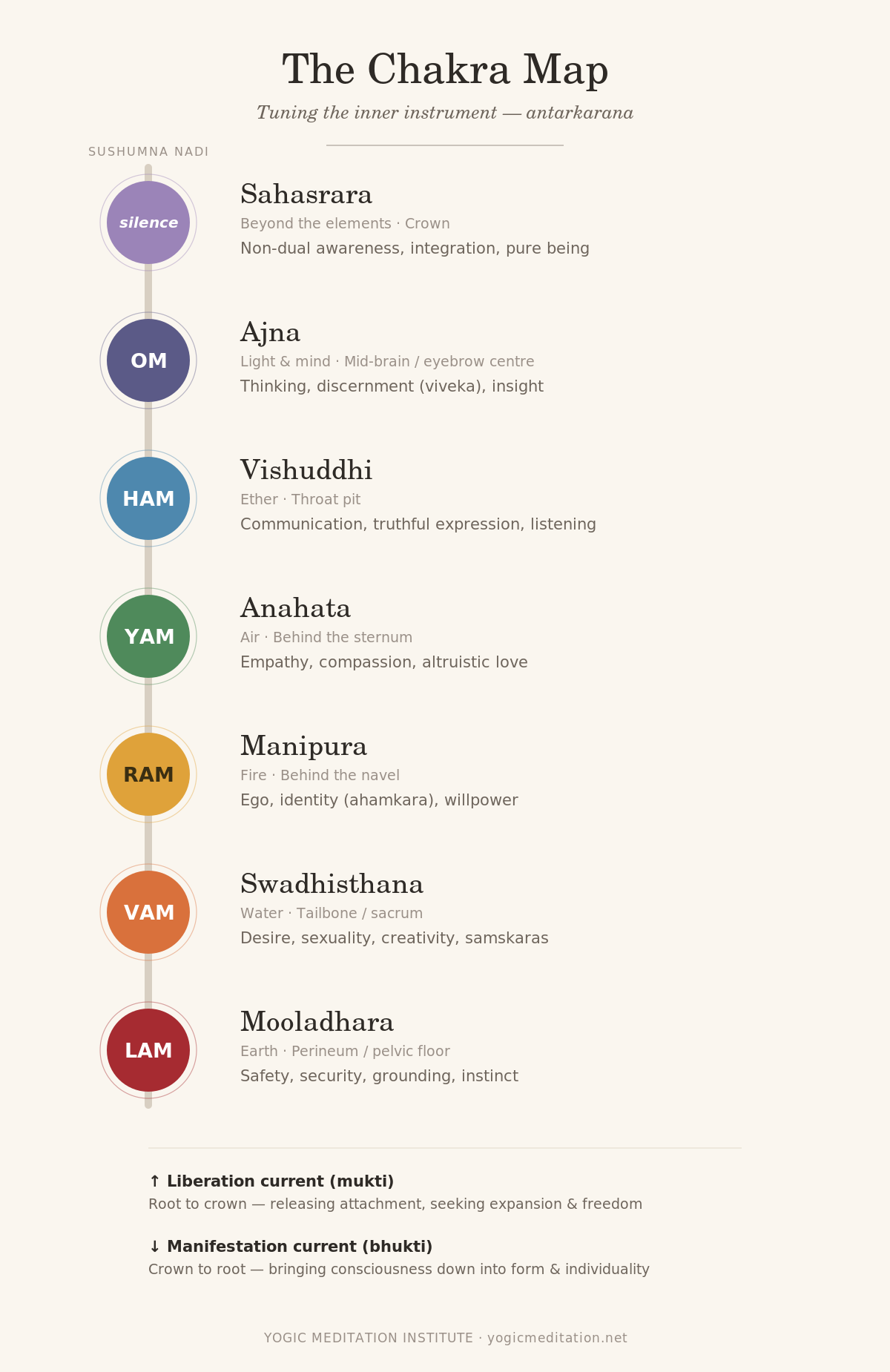
Each centre carries its own emotional signature, in this way the chakras become a map of the psyche and offer a methodology for the evolution of the individual.
Within each of us is the unique potential of our highest vibration. That potential is our dharma, our noble purpose. Refining Kundalini Shakti is the work of harmonising each chakra so that we might actually inhabit the frequency of that potential.
Two currents run through this system. The liberation current (mukti) rises from root to crown, releasing attachment and seeking expansion and freedom. The manifestation current (bhukti) descends from crown to root, bringing consciousness down into form, density and individuality. A complete practice honours both — we are here to expand and to show up in a life.
Emotional embodiment: feeling the feelings
This is the practical heart of chakra psychology, and it's what separates it from a colouring-in exercise.
Through witnessing our deepest thoughts, feelings and emotions, we learn where our challenges actually sit. Through practices like Antar Mouna we cultivate the witness consciousness — viveka — and learn to feel the feelings without letting the emotions rule or define us. By observing our repeating patterns of thought and feeling, we start to locate our energetic blockages, and to work out what practice or support we need to move through them.
Note that word: through. Emotional embodiment invites us to explore the whole gamut of human experience — lust or asexuality, ambition or fear, joy or rage — noticing the patterns as clues rather than problems. We are not trying to transcend past the experience. We are trying to work through it, fully embodying whatever lesson it holds. That is the difference between spiritual bypassing and spiritual practice.
Overlay the gunas onto this and the diagnostic gets sharper still. Tamas (inertia, stagnancy), rajas (restlessness, dynamism) and sattva (balance, clarity) are present in every aspect of our nature. Ask which guna is dominant in which chakra, and you have a genuinely useful lens for self-analysis — and, from there, an informed personal sadhana rather than a generic one.
Brighten the moon before you raise the sun 🌝 ☀️ 🔥
One last principle, and it's the one most often skipped.
In tantric philosophy, moon is Chandra — the mind, chitta. Sun is Surya — energy, prana, working through Manipura and the Pingala Nadi. Fire is Agni — Kundalini itself, illumination, working at Mooladhara and through Sushumna.
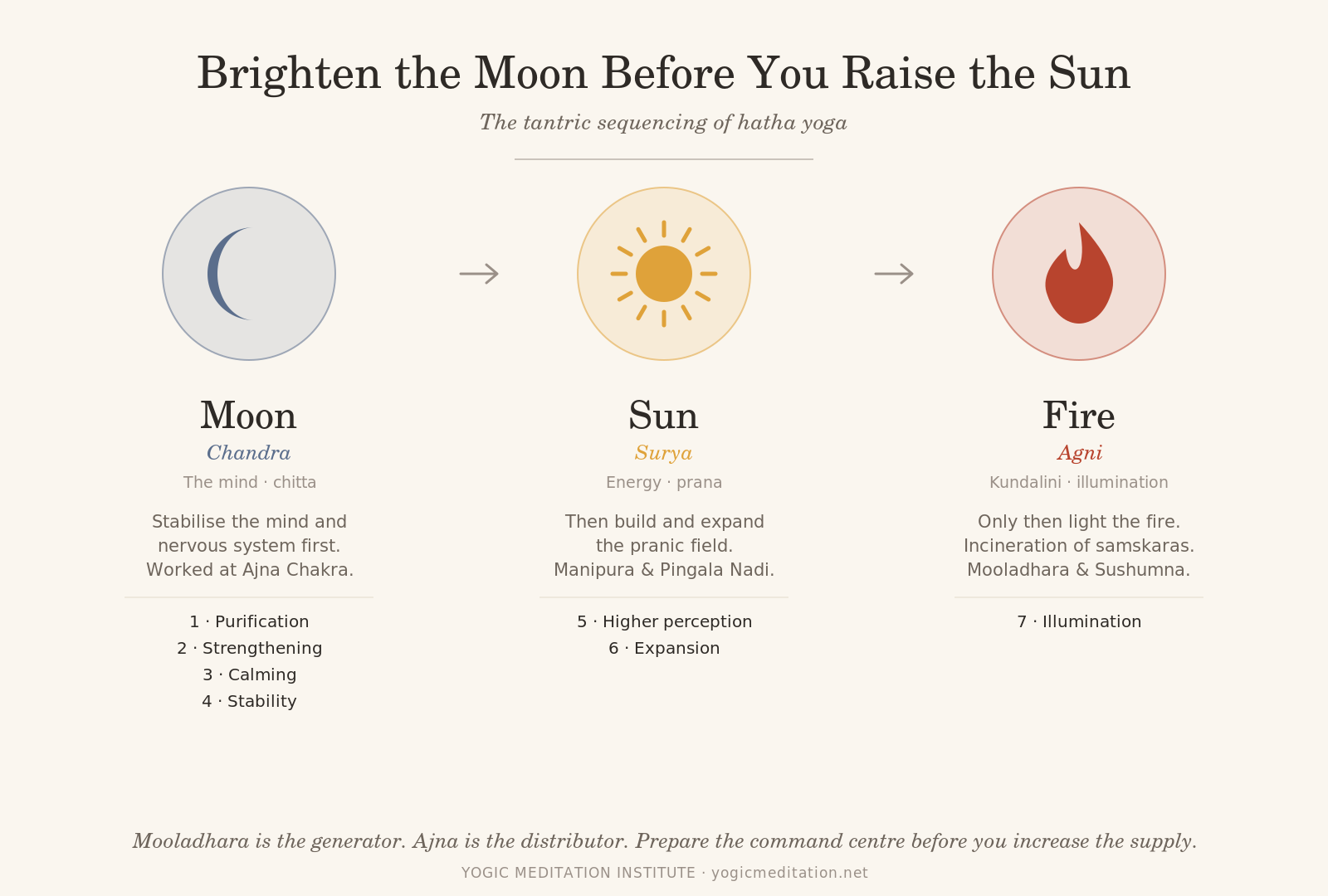
The traditional sequencing is unambiguous: brighten the moon before you raise the sun, and raise the sun well before you light the fire.
There's a physiological logic to this. Mooladhara is the storehouse of latent Kundalini Shakti — the pranic generator. Ajna is where that energy is received and distributed — the command centre. It would be foolish to increase the supply before the distributor is ready to manage it. So we stabilise the mind first, through meditation, mantra and karma yoga. Then we build the energy. Only then do we turn up the heat.
Practically, this is what a well-designed hatha progression looks like: purification, then strengthening, then calming, then stability — and only then the expansive, energising and finally illuminating work. Most modern yoga skips straight to step five.
Where to start
The good news it - if you already practise hatha yoga in any form, you have already begun — you're simply working with one layer of a system that has many.
The most reliable next step is to emphasise pranayama. Add breath retention (kumbhaka) with bandha, and you will sensitise your awareness to prana faster than almost anything else. Learn a few essential mantras — the chakra bija mantras and the Gayatri. Then begin exploring kriya, where asana, breath, mudra, bandha and mantra come together into what genuinely can become a sweet symphony of movement, awareness and awakening.
A caution worth repeating: layer slowly. Master each element individually before combining them, or you'll simply be confused in several dimensions at once. And while the foundational practices of Kundalini Yoga are entirely suitable for beginners, the advanced practices should only be explored under the guidance of a suitably experienced teacher.
Want to go deep into all of this?
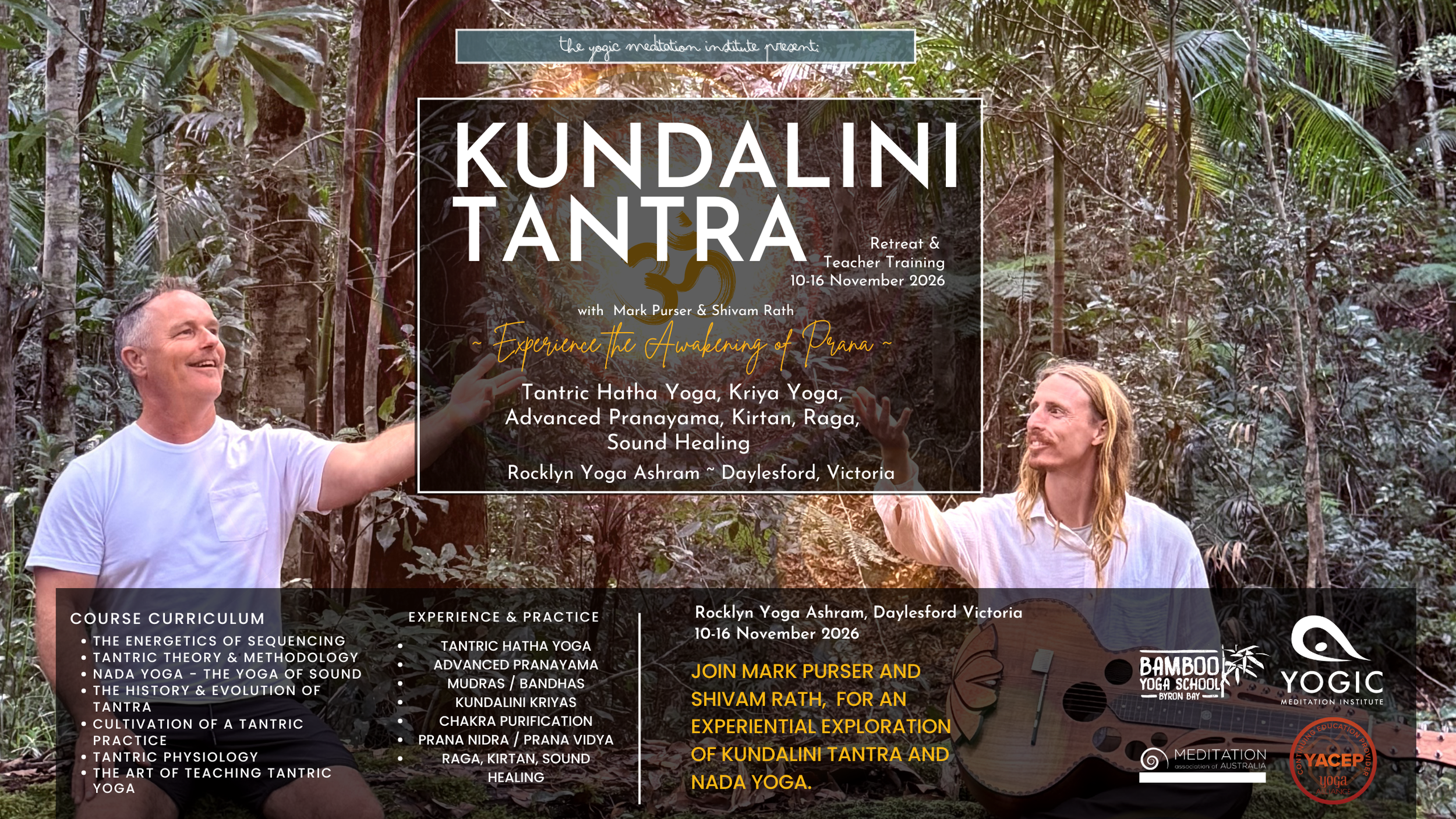
The Kundalini Tantra 7-Day Retreat & Teacher Training runs 10–16 November at Rocklyn Yoga Ashram in the Victorian highlands — seven days of tantric hatha yoga, kundalini kriya, advanced pranayama, chakra psychology and yoga nidra, with a musical tapestry of mantra and raga woven throughout by Shivam Rath. Comprehensive course manual, class recordings and all meals and accommodation included.
Mark Purser teaches in the tradition of classical yogic tantra in the lineage of Swami Satyananda and the Bihar School of Yoga.